 Garment GopherShirt shop software: from first quote to money in the bankCall or text 563-210-0678
Who owes us money? One list, oldest balance first, checked every Friday.
Friday, 4:50 PM. Your dad asks if the wrestling team ever paid for the hoodies, and the invoice book has a check mark nobody remembers making.
To track unpaid invoices, keep one list of every job that isn't paid in full: the customer, the balance, and how many days since it was due.
Sort it oldest first. Update it every Friday. Cross a line off the day the money lands.

One page: every balance, how late it is, who's on it, and the total.
Free, no sign-up. On a phone, pick Print, then Save as PDF.
Pull every unpaid job onto one list, from wherever it's written
In most shops the money is written in four or five places, and none of them agree.
Go through each one once:
- The invoice book or invoice folder
- The order book, for jobs that never got an invoice
- Boxes waiting by the door, since most of those owe a balance at pickup
- Venmo, PayPal and the card reader, for what already came in
- The cash drawer slips and the bank deposits
Anything with money still owed goes on the sheet. Anything paid in full stays off.
Write the balance, not the order total
A $875 hoodie order with a $400 deposit owes $475. Write $475.
If you write totals, the list says the shop is owed twice what it is, and somebody gets a call about money they already paid.
Next to each balance, write the date it was due. For most shirt jobs that's the day the order was ready for pickup.
Sort the list by how late each balance is
Count the days since each balance was due, then group them. Accountants call this an aging report. On paper it's three columns: 0 to 30 days, 31 to 60, and over 60.
Here's an example with four jobs:
- Hillcrest Softball, $336. Box ready 5 days ago.
- First Baptist youth group, $280. Picked up 23 days ago, half paid.
- Central Wrestling, $475. 41 days.
- Main St. Diner aprons, $310. 67 days, nothing paid.
That's $1,401 owed to the shop: $616 under 30 days, $475 at 31 to 60, and $310 over 60.
The oldest balance is the hardest one to collect, so it gets a phone call this week.
Go over the old ones with whoever kept the books
Before you call anybody, sit down with your mom or dad and read them the over-60 list.
Some of those got settled at the counter in cash. A regular might pay once a month on a handshake. One might have been traded for a sign out front.
Mark each one: still owed, settled, or let it go. They ran the books for years, and they know which ones are real.
Fifteen minutes every Friday keeps the list true
Pick one person and one time. Friday afternoon works, because the week's pickups are done.
Check Venmo, PayPal, the card reader and the cash slips against the sheet. Cross off what got paid, add any job finished this week with a balance, and redo the three totals.
A list nobody updates is worse than no list. It sends you after people who already paid.
Chase the late ones, and stop new ones at pickup
Anything past 30 days gets a follow-up on a schedule: a text, a call, then a notice in writing. Our post on what to do when a customer won't pay the balance has the texts and the notice.
If Venmo payments come in with no note and you can't tell whose they are, match every Venmo payment to its order the day it lands.
And keep the rule that the balance is due at pickup. A box that goes out the door unpaid is the one that ends up on this list.
This is the "who still owes" step from the plan for getting the shop off paper, and it's a good first one to move.
Where Garment Gopher fits
Garment Gopher keeps the deposit, the balance and the Paid tick on the same job, so every job not marked paid stays in front of you.
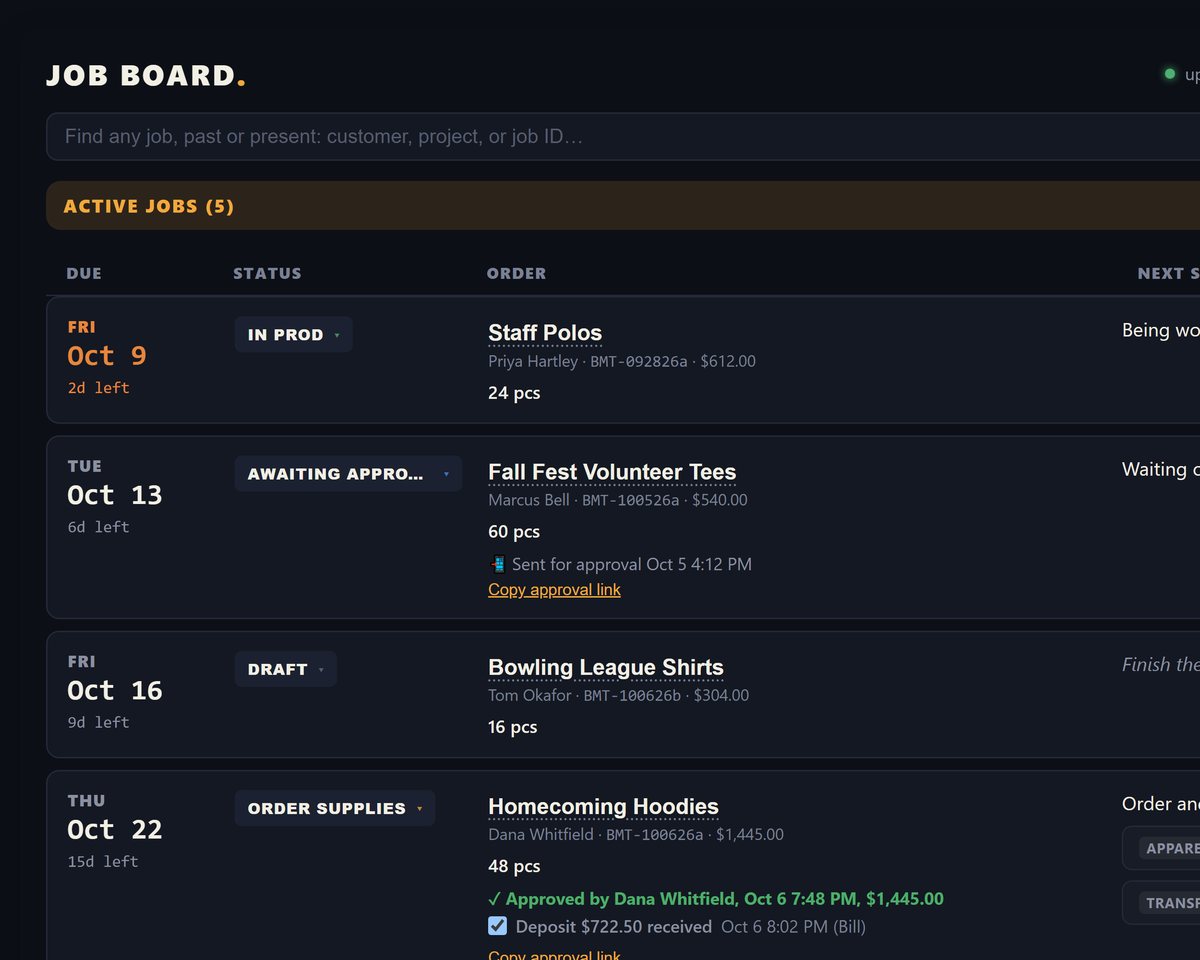
- Deposits: tick "Deposit received" and the job moves from Awaiting Deposit to Approved: Order Supplies, and the deposit comes off the invoice.
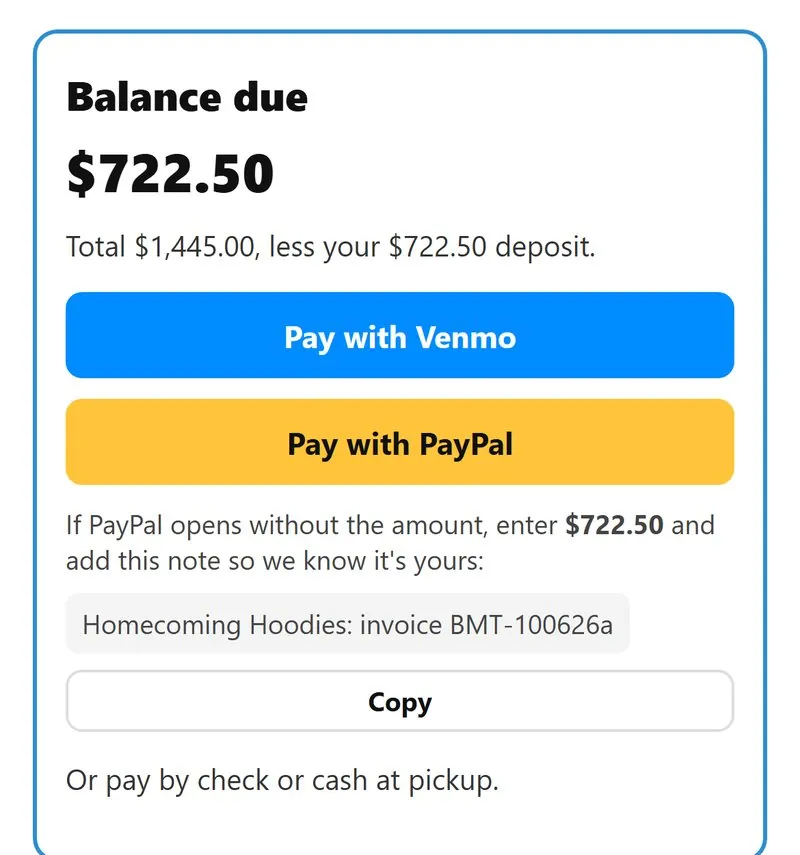
- The balance: the invoice link shows "Balance due" with Venmo and PayPal buttons and a payment note naming the job and invoice number, plus check or cash at pickup.
- Paid: tick Paid and the job moves to Paid, which folds into its own section. The invoice link then reads "Paid in full."
- Cards: connect your own Stripe and a card payment ticks the job by itself.
- QuickBooks Online: once you send a job over, its Deposit and Paid ticks show up as payments on that invoice.
It doesn't see Venmo, PayPal, cash or checks come in, so you tick those yourself. It won't text or email customers for you, and it doesn't add up one total owed, so the Friday sheet still has a job.
Everybody in the shop gets their own login at no extra charge. It's $79 a month, and the first 14 days are free with no card.
Start my free 14 days