 Garment GopherShirt shop software: from first quote to money in the bankCall or text 563-210-0678
How much to charge for 2XL shirts. Start from what the bigger blank costs you.
The size list for the coworker order comes back, and four of the six hoodies are 2XL or 3XL.
Charge each big size at least what its blank costs you over an XL, rounded up to the dollar.
Double that if you want the same margin as the rest of the order.

One page. Work out the upcharge for each size from your own blank costs, then check one flat step against every garment you sell.
Free, no sign-up. On a phone, pick Print, then Save as PDF.
A flat $2 a size covered the tee in our example below. It came up short on the hoodie. Here's how to check yours.
Find what each big size costs you over an XL
Look up your blank's price for XL, then for each size above it. Subtract. That's what the bigger shirt costs you over an XL.
These examples use made-up blank costs. Use your supplier's price for each size, since they change by style and color.
- Tee: XL $3.50, 2XL $5.00, 3XL $5.75. The 2XL costs you $1.50 more, the 3XL $2.25 more.
- Hoodie: XL $13.00, 2XL $16.00, 3XL $17.50. The 2XL costs you $3 more, the 3XL $4.50 more.
In these examples the DTF transfer is $3 on every size, so the blank is the only cost that changes.
Charge 2XL and 3XL at least the difference, rounded up
Round each difference up to the next dollar. That keeps at least the same profit in your pocket as an XL.
- Tee: 2XL $1.50 becomes $2. 3XL $2.25 becomes $3.
- Hoodie: 2XL stays $3. 3XL $4.50 becomes $5.
Want the same margin, not just the same dollars? At a 50 percent margin, double the difference first. That's $3 and $5 on the tee, $6 and $9 on the hoodie.
Same dollars is the least you charge. Same margin is the top of the range. Pick your number in between and write it on the sheet.
Check one flat step against your hoodies
A flat step is simpler: $2 for 2XL, $4 for 3XL, $6 for 4XL, on every garment. Here's what it does to the examples.
- Tee 2XL: $2 step, $1.50 more cost. You keep $0.50 more than on an XL.
- Tee 3XL: $4 step, $2.25 more cost. You keep $1.75 more.
- Hoodie 2XL: $2 step, $3 more cost. You keep $1 less.
- Hoodie 3XL: $4 step, $4.50 more cost. You keep $0.50 less.
Say the XL hoodie is $35 and costs you $16 with the transfer. You keep $19.
The 2XL at $37 costs you $19, so you keep $18. The 3XL at $39 keeps $18.50.
That's small on one order. On a team order with 20 big hoodies, it's $10 to $20 handed back.
Two fixes. Use a bigger step on hoodies, or one step big enough for your priciest blank. A $3 step covers both examples at 2XL and 3XL.
Put the size prices on the quote before they say yes
An extra $2 that shows up on pickup day starts an awkward talk with a friend. Put it on the quote. A line you can copy:
"2XL and up cost me more for the blank shirt, so a 2XL tee is $2 more and a 3XL is $3 more."
Need the regular price first? The free price calculator builds it from your blank and transfer cost for every order size.
It uses a $2 step for big sizes. Check that step against your hoodies with the sheet here.
Setting the least you'll take on a shirt is in what to charge friends for custom shirts.
The DTF vs screen printing cost worksheet shows which method is cheaper at 24, 48 and 72.
Where Garment Gopher fits
Garment Gopher adds a flat step to every size above XL: one step on a 2XL, two on a 3XL, up to five on a 6XL.
A new shop starts at $2 a step, and you set your own in Settings.
Each size box shows its step, like +$2 and +$4, and the quote lists each size's own price. Youth, toddler and tall sizes price off their own blank's cost.
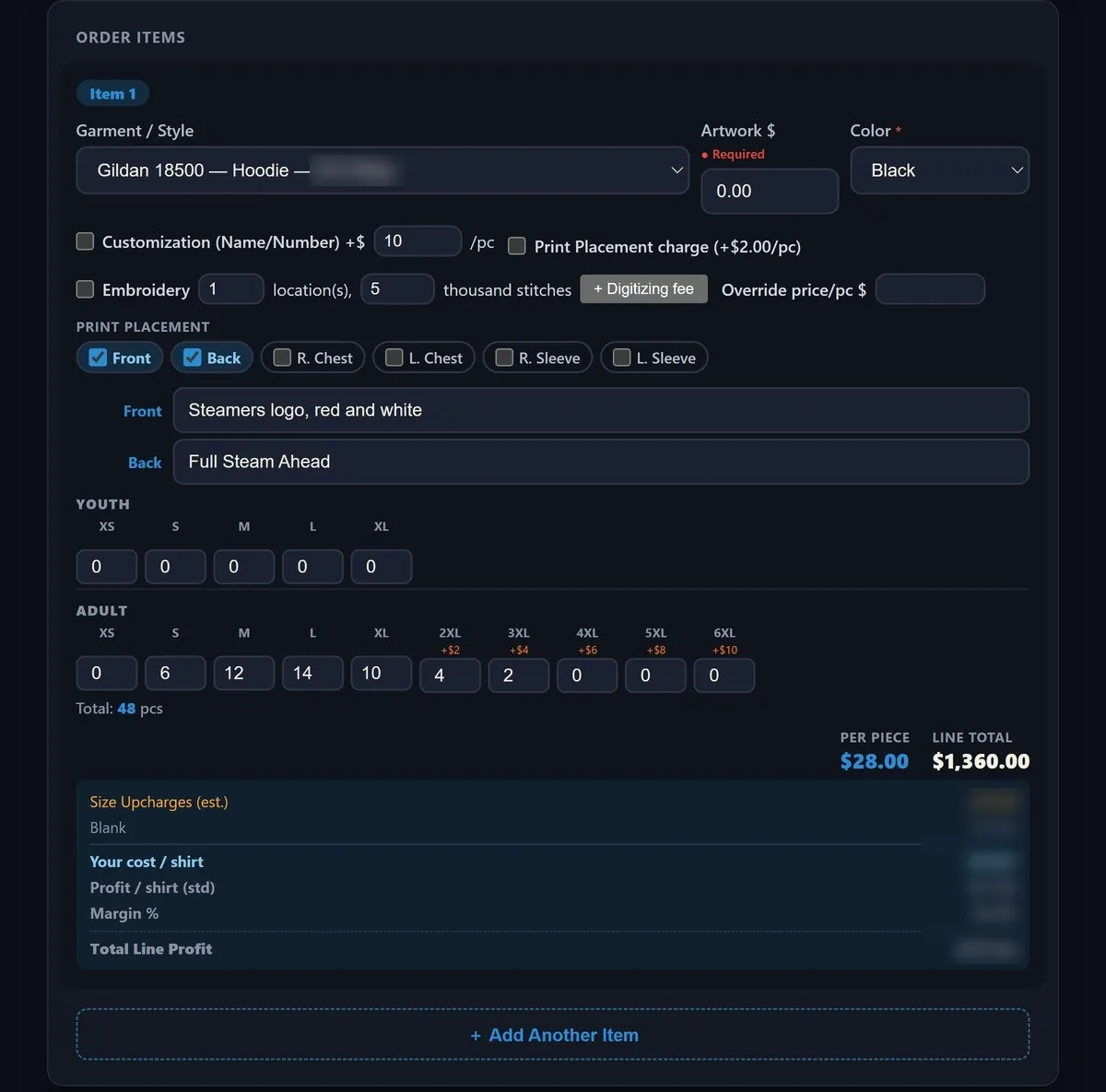
Your cost, profit and margin show on every line while you quote. The customer never sees them.
The app counts the step as what the bigger blank costs you, so a 2XL shows the same profit as an XL.
It doesn't take a separate 2XL or 3XL blank price, and the step is one number for every garment.
So if your 2XL hoodie blank costs $3 more and your step is $2, the profit on screen runs $1 high on each one.
Work out your hoodie on the sheet, then pick a step that covers it.
It's $79 a month, everybody in the shop logs in, and the first 14 days are free with no card.
Start my free 14 days