 Garment GopherShirt shop software: from first quote to money in the bankCall or text 563-210-0678
T-shirt quantity price breaks that still pay you. Take dollars off and find the cliff.
A softball coach at the front counter asks why 48 shirts cost less than the 44 she needs. Good t-shirt quantity price breaks take dollars off each shirt as the order grows, never go under your floor, and never let a bigger order cost less.

One page. Check each break against your floor for two garments, find the cliff at every break, and work out whether selling up pays you.
Free, no sign-up. On a phone, pick Print, then Save as PDF.
Her math holds up. At $16 a shirt, 44 comes to $704. At the 48-piece price of $14, 48 shirts come to $672. Here's how to set breaks that don't do that.
Set t-shirt quantity price breaks in dollars, not percents
Start from your regular price: what one shirt costs you, times 2 for a 50 percent margin. In these examples a tee costs you $6.50, a $3.50 blank and a $3 DTF transfer, so the regular price is $13.
Then add or take off dollars by the size of the whole order:
- 1 to 11 shirts: $4 more, $17
- 12 to 47: $3 more, $16
- 48 to 71: $1 more, $14
- 72 to 143: the regular price, $13
- 144 and up: $1 off, $12
Count the break from the whole order. Thirty tees and twenty hoodies on one job are 50 pieces, and both lines get the 48 price.
What gets cheaper on a big order is your setup and handling per shirt. One art file, one press setup, one trip to the box. That saving is about the same on a hoodie as on a tee, so take it off in dollars.
A percent doesn't follow it. At 30 percent off, a $36 hoodie loses $10.80 and a $17 tee loses $5.10, for the same saved setup.
Check every break against your floor
Your floor is the least you'll take for one shirt. The example uses two rules and keeps the higher one: your cost plus $4, or the price that keeps 35 percent for you (cost divided by 0.65). Round up to the dollar.
- Tee, $6.50 cost: $10.50 or $10, so the floor is $11.
- Hoodie, $16 cost (a $13 blank and the same $3 transfer): $20 or $24.62, so the floor is $25.
The dollar breaks clear both floors everywhere. The tee bottoms out at $12 and the hoodie at $31.
Now say your sheet takes 10, 20, 30 and 40 percent off the small-order price at 12, 48, 72 and 144 instead. At 72 the tee is $11.90 and the hoodie is $25.20, barely over.
At 144 the tee is $10.20 and the hoodie is $21.60, both under. The hoodie misses by $3.40 a shirt, $489.60 on 144, on the biggest job of your month.
Check every garment you sell. A break that's fine on a tee can sink a hoodie.
Find the cliff where a bigger order costs less
Just under every break is a stretch where the customer pays more than the next break would cost. To find where it starts, multiply the next break's first count by its price, then divide by your current price.
- 48 x $14 = $672. $672 / $16 = 42. Orders of 43 to 47 pay more than 48 would.
- 72 x $13 = $936. $936 / $14 = 66.9. Orders of 67 to 71.
- 144 x $12 = $1,728. $1,728 / $13 = 132.9. Orders of 133 to 143.
The break at 12 has none: 11 shirts at $17 is $187, and 12 at $16 is $192.
Two fixes. Make the step smaller: $15 at 48 instead of $14 shrinks that cliff to 46 and 47. Or keep the step, and when an order lands in the cliff, quote both counts and let the customer pick.
Selling up to the next break has to pay you too
Moving the coach from 44 to 48 saves her $32. It costs you more than that.
- 44 tees at $16: $9.50 profit each, $418.
- 48 tees at $14: $7.50 profit each, $360. You print four more shirts and keep $58 less.
- 58 tees at $14: $435, the first count that beats the 44 by at least $10.
So work out both totals and both profits before you point at the bigger count. Sometimes you'll take the smaller profit to keep a good customer. Decide that on purpose, with the numbers in front of you.
Not sure your regular price is right to start with? The free price calculator builds this same ladder from your blank and print cost, for every order size.
Setting the floor itself is covered in what to charge friends for custom shirts. The DTF vs screen printing cost worksheet shows which method is cheaper at 24, 48 and 72.
This is step three of every quote: moving the price by the size of the order. Our guide on how to quote custom t-shirts walks one order from the first text to a written price.
Where Garment Gopher fits
Garment Gopher prices every DTF line this way: blank plus transfer, times 2 at your margin, plus or minus a dollar amount set by the whole order's piece count. A new shop starts with the breaks in this post, and you can change, add or remove them.
Screen print lines use a run charge by number of colors that drops as the order grows.
The floor is built in. The pricing never puts a shirt below your cost plus your least profit ($4 to start) or your least margin, whichever is higher. A line that hits the floor is flagged.
Every line shows your cost, profit and margin while you quote. The customer never sees them.
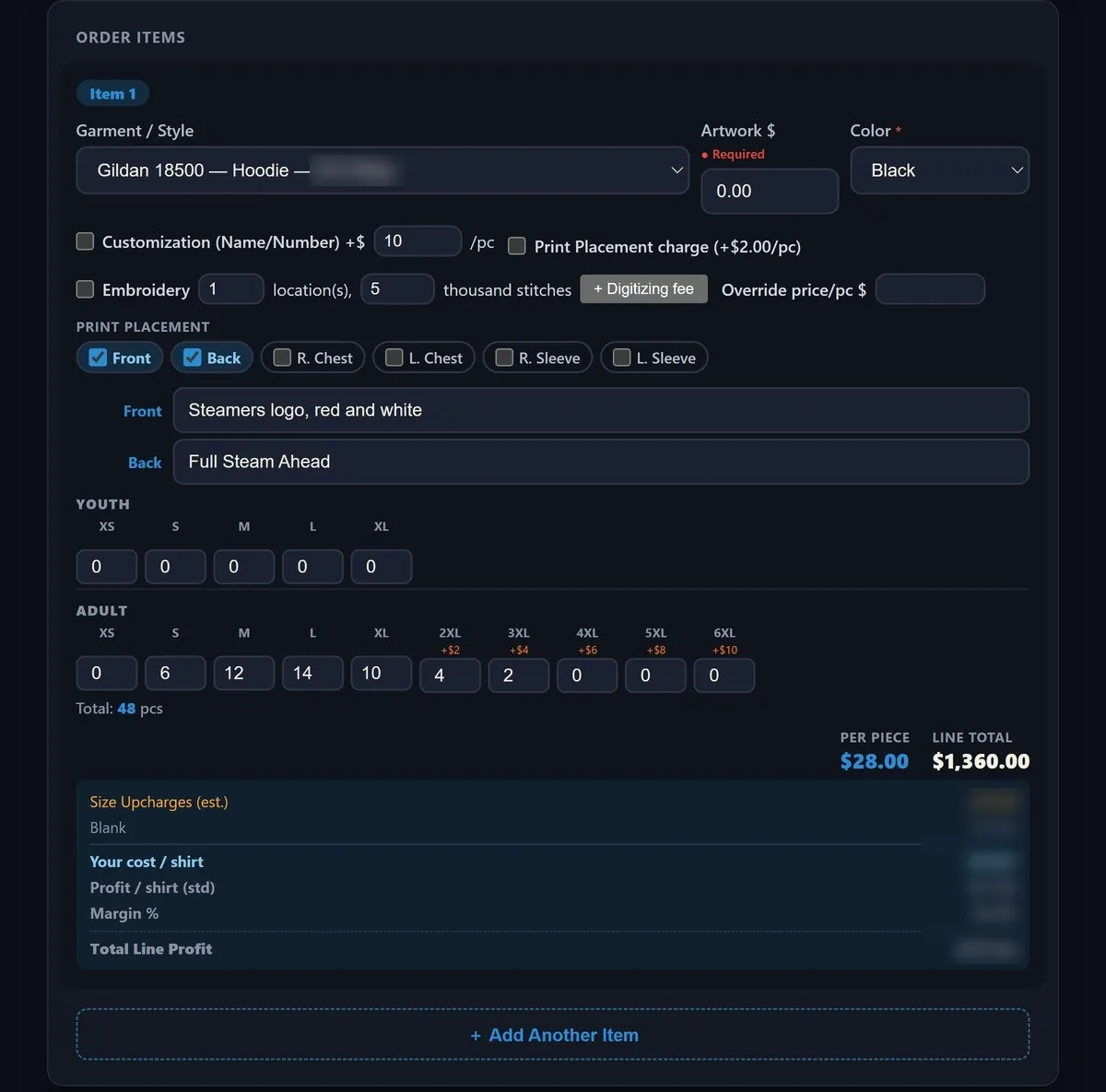
When an order sits a few pieces under the next break, a hint only the shop sees says how many more pieces would save the customer money and make you at least $10 more. It also says when just reaching the break would lose you money.
"A few" is within 12 pieces or half the order, and you can change both. The quote tells the customer what the breaks saved them.
The starter breaks drop $2 a shirt at 48, so they have the same cliff as the coach's order. The app doesn't cap an order in the cliff at the next break's total. Change the step at 48, or quote both counts.
It's $79 a month, everybody in the shop logs in, and the first 14 days are free with no card.
Start my free 14 days