 Garment GopherShirt shop software: from first quote to money in the bankCall or text 563-210-0678
How to quote custom t-shirts. Six steps from "how much for 18?" to a price you can text back.
It's 9:40 on a Monday night, and the text reads: "How much for 18 shirts for the softball team? Two of the coaches need 2XL."
To quote custom t-shirts, add up your cost, pick the method, double it and adjust for the order size. Then check your floor, add the 2XL step, and write it down with a deposit.
%3C/text%3E%3C/g%3E%3Cg stroke='%23cccccc' stroke-width='1'%3E%3Cline x1='24' y1='143' x2='536' y2='143'/%3E%3Cline x1='24' y1='189' x2='536' y2='189'/%3E%3Cline x1='24' y1='235' x2='536' y2='235'/%3E%3Cline x1='24' y1='281' x2='536' y2='281'/%3E%3Cline x1='24' y1='327' x2='536' y2='327'/%3E%3Cline x1='24' y1='373' x2='536' y2='373'/%3E%3C/g%3E%3Ctext x='24' y='446' font-size='19' fill='%23c8371b' font-weight='700'%3EDue Dec 4. Good until Dec 16. Signed: Y%3C/text%3E%3Ctext x='24' y='478' font-size='15' fill='%23777777'%3EFree sheet from GarmentGopher.com%3C/text%3E%3C/svg%3E)
One page, one box for each step. Fill it in top to bottom and the price is done before you text back.
Free, no sign-up. On a phone, pick Print, then Save as PDF.
Each step below has its own post with the details. The whole softball quote is worked out at the end.
1. Add up what one shirt really costs you
Start with the blank and the print: the shirt, plus the transfer, the ink or the thread. In our example, a $3.50 tee and a $3 DTF transfer cost you $6.50.
Shipping on the blanks and the shirt you'll ruin add a little more. What to charge friends for custom shirts works out the full cost line by line.
2. Pick DTF, screen print or embroidery before you price
If a heat press is all you've got, this one's already picked. If you also screen print, each method costs you something different, so the price starts there.
DTF usually wins short runs. Screen printing wins once the screens are spread over enough shirts. Find your own line at 24, 48 and 72 with the DTF vs screen printing cost worksheet.
For hats and polos, how to price embroidery prices each location and its stitches.
3. Double the cost, then move it by the size of the order
Doubling your cost keeps half the price for you, a 50 percent margin. The example tee's regular price is $13.
Then add or take off dollars by how many pieces are on the whole order. In the example it's $3 more for 12 to 47 pieces, so 18 shirts are $16 each.
The full break table, and the cliff where a bigger order costs less, are in t-shirt quantity price breaks.
4. Check the price against your floor
Your floor is the least you'll take for one shirt. The example keeps the higher of two numbers: your cost plus $4, or the price that keeps 35 percent for you.
For the $6.50 tee that's $10.50 or $10, rounded up to $11. The $16 price clears it. A break or a friend price that drops under $11 doesn't go out.
The free shirt price calculator builds the price for every order size from your blank and transfer cost, and keeps the same $4 and 35 percent floor.
5. Price the 2XLs on their own line
A 2XL blank costs more than an XL. In the example the tee's XL is $3.50 and the 2XL is $5, so each 2XL costs you $1.50 more.
Charge at least that, rounded up. A $2 step makes the coaches' shirts $18. Check the step on hoodies too, where the gap was bigger in our example.
The upcharge sheet is in how much to charge for 2XL shirts.
6. Write it down with two dates, a deposit and a signature
A price in a text gets remembered wrong. Put the sizes, the price for each size, the due date and a good-until date on one page.
Ask for a deposit of half the total or your cost, whichever is more, and get a signature before you order blanks. The screen printing quote template works for DTF orders too.
What comes after the yes, from the deposit to pickup, is in the custom t-shirt order process.
The softball quote, start to finish
- Cost: $3.50 blank plus a $3 transfer is $6.50. The 2XL blank is $5, so those cost $8.
- Price: $6.50 times 2 is $13. Eighteen pieces gets $3 more, so $16.
- Floor: $11. The $16 clears it.
- 2XL: $16 plus the $2 step is $18.
- Total: 16 shirts at $16 is $256, plus 2 at $18 is $36. That's $292.
- Deposit: half is $146. The shirts cost you $120, so ask for $146.
You keep $172 on the order, before shipping on the blanks and your time at the press.
Text back the total, the price per size and the due date. Then send the written quote and wait for the signature and the deposit.
These are example costs. Swap in your supplier's prices and your own transfer cost, and the six steps stay the same.
Where Garment Gopher fits
Garment Gopher runs steps one through five on every line while you type, and step six is the quote it prints.
Pick the blank from the catalog or type your own cost. Pick DTF, screen print or embroidery on each line, or Auto, which prices DTF and screen print both ways and keeps the cheaper one.
DTF lines price from your blank and transfer cost at your margin, then the order's price break. A new shop starts with the same breaks as our example, and you can change them.
No piece goes below your floor: your cost plus your least profit, $4 to start, or your least margin, whichever is higher. 2XL and up add a flat step, $2 to start.
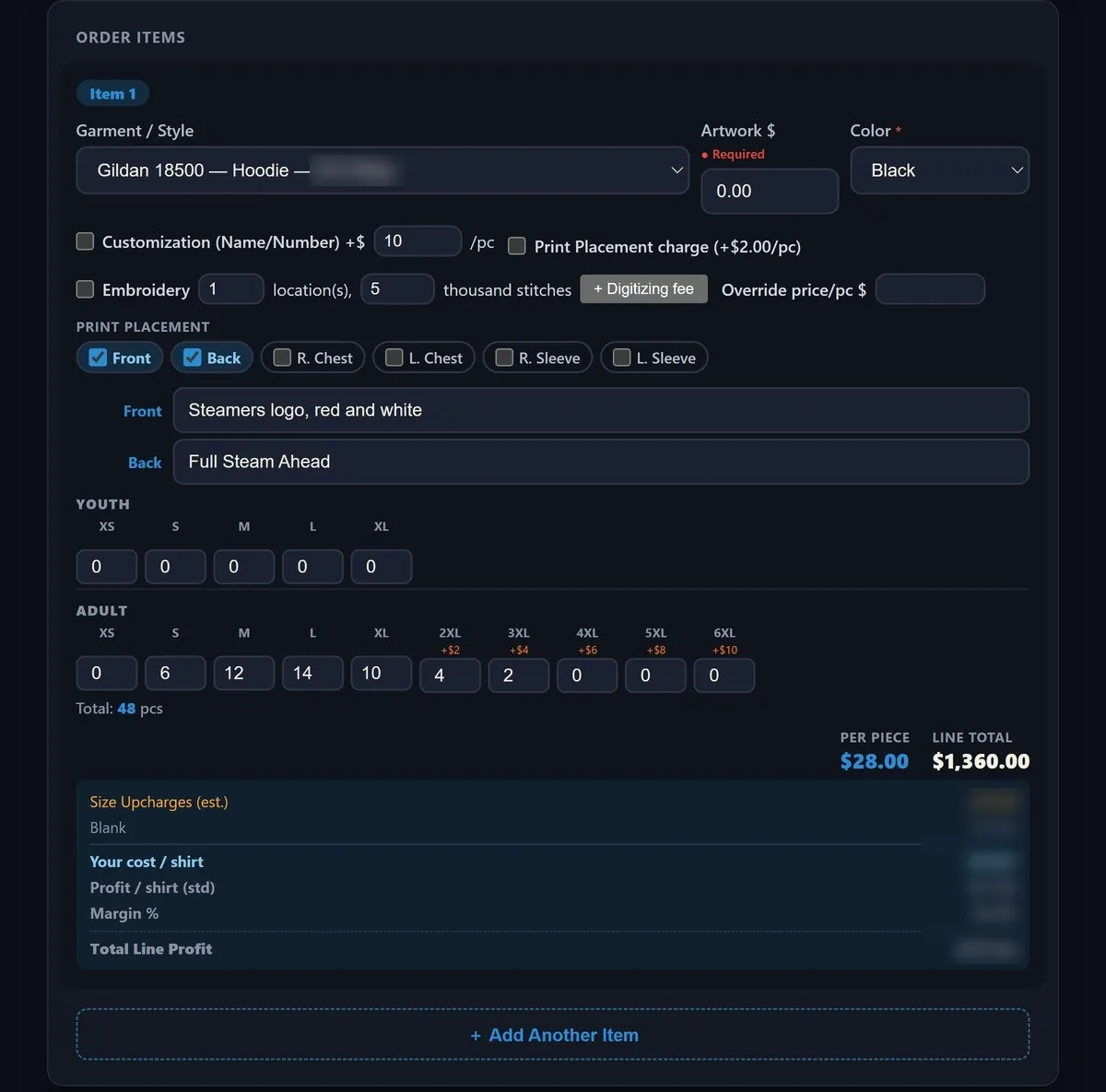
Your cost, profit and margin show on every line, and the customer never sees them.
Catalog blanks also carry your supplier's card fee, 3 percent to start, so the app's numbers can differ a little from the hand math.
The quote lists a price for each size and says it's good for 30 days.
It goes out as a private link, the customer types their name to approve, and a deposit can be paid by Venmo, PayPal, or card once you connect your own Stripe.
The quote's terms are fixed text. Screen fees are spread into the line's price, so there's no separate screens line.
It's $79 a month, everybody in the shop logs in, and the first 14 days are free with no card.
Start my free 14 days